March 10 African American Historical Events

* Today in Black History – March 10 *

1850 – Hallie Quinn Brown is born in Pittsburgh, Pennsylvania. She
will become a Black educator and elocutionist who will
pioneer the movement for Black women’s clubs in the United
States. The daughter of former slaves, she will receive a
B.S. from Wilberforce University in Ohio in 1873. She will
then teach on plantations and in the public schools of
Mississippi and South Carolina. After graduating from the
Chautauqua Lecture School, and teaching in Dayton, Ohio,
and in Alabama, she will return to Wilberforce to teach
elocution. At that time she will begin her extensive travels
as an elocutionist and lecturer, speaking in Europe as well
as the United States on topics of the life of Blacks in
America. She will assist in founding the earliest women’s
clubs for Blacks and, from 1905 to 1912, will serve as
president of the Ohio State Federation of Colored Women’s
Clubs. She will also help to found the Colored Women’s
League of Washington, D.C., a predecessor of
the National Association of Colored Women. She will also
author “Homespun Heroines and Other Women of Distinction,”
a 1926 collection of biographical sketches of notable
African American women. She will join the ancestors on
September 16, 1949, in Wilberforce, Ohio.

1863 – Two U.S. African American infantry regiments, the First and
Second South Carolina Volunteers, capture and occupy
Jacksonville, Florida, causing panic along the Southern
seaboard. These regiments are not to be confused with the
confederate army First South Carolina Volunteers Infantry
Regiment.

1910 – The Pittsburgh Courier begins publishing. It will become one
of the most influential African American newspapers in the
country. In 1966, it will change its name to the “New
Pittsburgh Courier,” and continue to operate as a semi-weekly
publication. In 1987, the Courier will be the winner of the
John B. Russwurm award for excellence in responsible
journalism given by the National Newspaper Publishers
Association to the top African American Newspapers in America.

1913 – Harriet Tubman joins the ancestors in Auburn, New York. An
escaped slave, Tubman was known to the Underground Railroad as
“Black Moses” for her heroic trips south to free hundreds of
slaves. During the Civil War, she served as a scout, spy,
cook, and nurse.

1963 – Jasmine Guy is born in Boston, Massachusetts. She will become
an actress on television and will be best known for her role
as “Whitley” in the series “A Different World.”

1969 – James Earl Ray pleads guilty in the first degree to the murder
of Dr. Martin L. King, Jr. and will be sentenced to 99 years
in prison. The House Select Committee on Assassinations will
later state that although it believes Ray shot King, Ray was
part of a larger conspiracy. Ray will later repudiate that
plea, maintaining his innocence until his death.

1972 – Three thousand delegates and five thousand observers attend
the first African American political convention in Gary,
Indiana. The NAACP and other groups withdraw from the
convention after the adoption of resolutions that are critical
of busing and the state of Israel.

1990 – Haitian ruler Lt. Gen. Prosper Avril resigns during a popular
uprising against his military regime.

Information retrieved from the Munirah Chronicle and is edited by Mr. Rene’ A. Perry.
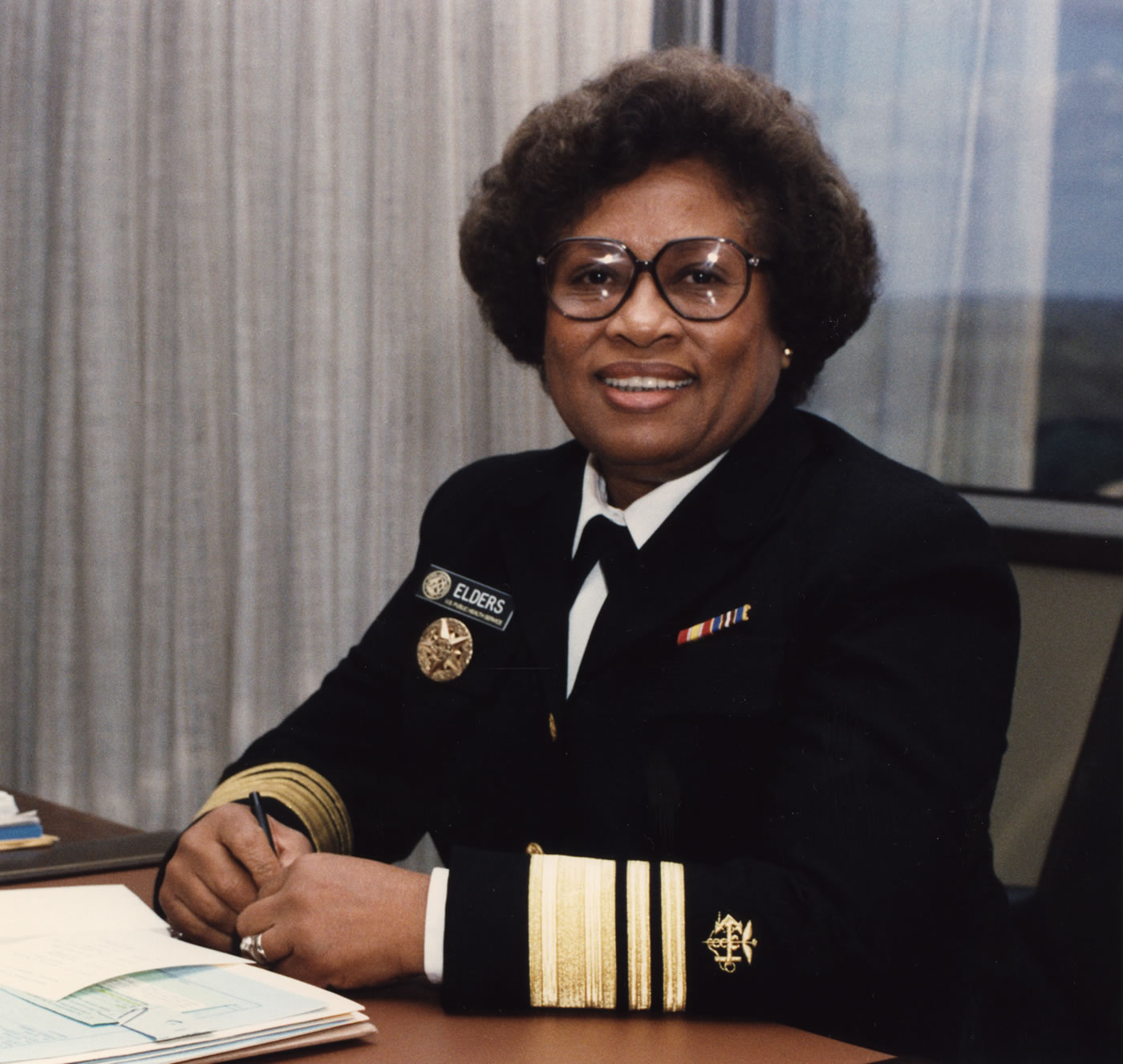
Day 9 Woman of the Day: M. Joycelyn Elders

Joycelyn_EldersDay 9 Woman of the Day is M. Joycelyn Elders, who was appointed Surgeon General, and later fired, during the Clinton Administration.  Read about this controversial woman below.

National Library of Medicine: http://www.nlm.nih.gov/changingthefaceofmedicine/physicians/biography_98.html

Black Past.org: http://www.blackpast.org/aah/elders-joycelyn-minnie-1933

NPR.org: http://www.npr.org/templates/story/story.php?storyId=10540974

March 9 African American Historical Events

* Today in Black History – March 9 *

1841 – Sengbe Pieh, known as Joseph Cinque, and the surviving African
slaves who revolted on the ship Amistad are ordered freed by
the United States Supreme Court and return to Africa after
successfully appealing their mutiny conviction on grounds that
they were kidnapped by outlawed slave traders. Their defense
attorney is John Quincy Adams, former President of the United
States and a Massachusetts senator. Before reaching the
Supreme Court, U.S. President Martin Van Buren appeals twice
the decision of lower courts to free the slaves. View the
original documents of the U.S. Supreme Court at:
http://www.archives.gov/education/lessons/amistad/supreme-court-statement.html

1871 – Oscar Stanton De Priest is born in Florence, Alabama. He will
be the first African American to be elected to Congress from
outside the southern states and the first in the 20th century.
He will represent Illinois for ten years and be an active
advocate for pensions for African American ex-slaves, lynching
prevention, and civil rights improvements. He will join the
ancestors on May 12, 1951.

1891 – The North Carolina Agricultural & Technical State University is
founded in Greensboro.

1892 – Three friends of Ida B. Wells-Barnett, prominent African
American businessmen, are lynched in Memphis, Tennessee after
an incident that stemmed from their opening a grocery store
across the street from a white-owned grocery store.

1911 – White firemen of the Cincinnati, New Orleans and Texas Pacific
Railroad struck to protest the hiring of African American
firemen. (For those who don’t remember steam engines, firemen
worked in the engine stoking the fire, which kept the steam
generator going)

1914 – The “New” Southern University campus opens in Scotlandville,
Louisiana near Baton Rouge with nine teachers and 47 students.

1930 – Ornette Coleman is born in Fort Worth, Texas. He will become a
self-taught musician, beginning on alto saxophone when he is
fourteen and moving on to the tenor saxophone when he is
sixteen. He will be influenced by Charlie Parker, Illinois
Jacquet and Big Jay McNeely. A born improvisionalist, he
found it difficult to fit into his school band as well as the
mainstream groups that he will later join. It wasn’t until
the late 1950’s that he will be recognized for his jazz
innovations. He will name his musical method “harmolodics.”
Many musicians and critics and jazz listeners will reject his
new jazz as formless and abstract. However, critics of his
method will recognize his importance as a composer. Critics
will praise his compositions, including “Peace,” “Lonely
Woman,” and “Beauty Is a Rare Thing.” In 1967 he will win
a Guggenheim fellowship, the first granted to a jazz musician.
He will compose and perform film scores, including “Chappaqua”
(1965), “Box Office” (1981), and “Naked Lunch” (1991). In
1997 the New York Philharmonic will perform his “Skies of
America,” a large-scale work that was first recorded by the
London Symphony Orchestra in 1972. His album “Sound Grammar”
will receive the 2007 Pulitzer Prize for music.

1931 – Walter F. White is named NAACP executive secretary.

1933 – Lloyd Price is born in Kenner, Louisiana. He will become a
successful Rhythm & Blues artist and will record “Lawdy Miss
Clawdy” (’52 #1 R&B), “Oooh, Oooh, Oooh” (’52 #4 R&B), “Ain’t
It A Shame” (’53 #4 R&B), “Just Because” (’57 #3 R&B, #29
Pop), “Stagger Lee” (’58 #1 R&B, #1 Pop), “Where Were You (On
Our Wedding Day)” (’59 #4 R&B, #23 Pop), Personality” (’59 #1
R&B, #2 Pop), and fifteen other hits.

1948 – Jeffrey Osborne is born in Providence, Rhode Island. He will
become an accomplished rhythm and blues singer performing as
lead singer for the group LTD. He will later become a
successful solo artist.

1964 – Miriam Zenzi Makeba speaks before the United Nations about the
apartheid system in South Africa.

1965 – Three white Unitarian ministers, including the Rev. James J.
Reeb, are attacked with clubs on the streets of Selma,
Alabama, while participating in a civil rights demonstration.
Reeb will later die in a Birmingham, Alabama hospital.

1966 – Andrew F. Brimmer becomes the first African American governor
on the Federal Reserve Board.

1971 – Emmanuel Lewis is born in Brooklyn, New York. He will become
a child actor and will be best known for his television role
as “Webster.”

1997 – The popular “gangsta rapper” Notorious B.I.G., whose real name
is Christopher Wallace, joins the ancestors after being killed
in a drive-by shooting in Los Angeles, California at the age
of 24.

Information retrieved from the Munirah Chronicle and is edited by Mr. Rene’ A. Perry.

Libros Latin@s: Celebrating When Reason Breaks by Cindy L. Rodriguez

Unknown's avatarLatinxs in Kid Lit

This post is a little different from our usual Libros Latinos features in that it focuses on the release of our very own Cindy L. Rodriguez’s debut YA novel, When Reason Breaks, which is available now. Cindy wasn’t sure she wanted us to blog about her book at all, but we persuaded her that readers would want to know more about the rock-star author whose initiative brought Latin@s in Kid Lit into the world. This post is more a celebration than a review, but we aim to celebrate in a way that’s useful to readers, teachers, librarians, and advocates of Latin@ literature. Read on to hear from Latin@s in Kid Lit bloggers Ashley, Lila, Zoraida, and Sujei!

WhenReasonBreaks_Comp

Publisher’s Description: A Goth girl with an attitude problem, Elizabeth Davis must learn to control her anger before it destroys her. Emily Delgado appears to be a smart, sweet girl with…

View original post 1,215 more words