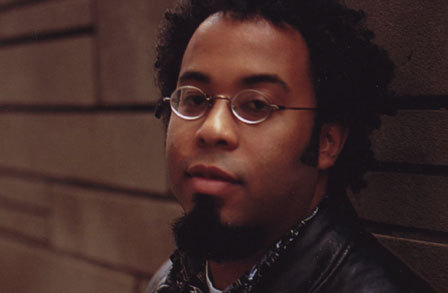
April 10 Poet of the Day: Kevin Young

Kevin Young, born in Lincoln, Nebraska, is April 10 Poet of the Day.  Read more about this award winning poet below.

kevin-young

Website: http://kevinyoungpoetry.com/home.html

Poetry Foundation: http://www.poetryfoundation.org/bio/kevin-young

Poets.org: http://www.poets.org/poetsorg/poet/kevin-young

NPR: http://www.npr.org/2014/03/04/285712680/kevin-young-on-blues-poetry-and-laughing-to-keep-from-crying

PBS: http://www.pbs.org/wgbh/poetryeverywhere/young.html

Youtube video: “Blending Music in Poetry”: https://www.youtube.com/watch?v=RZ7s8xIp7dk

Poem “The Dry Spell”

<!–

–>

The Dry Spell

Kevin Young, 1970
Waking early
with the warming house
my grandmother knew what to do
taking care not to wake
Da Da 		she cooked up a storm
in darkness 	adding silent spices
and hot sauce

to stay cool. She ate later, alone
after the children had been gathered
and made to eat
her red eggs. Da Da rose
late, long after
the roosters had crowed
his name, clearing
an ashy throat
pulling on long
wooly underwear
to make him sweat

even more. The fields have gone
long enough without water
he liked to say, so can I
and when he returned
pounds heavier
from those thirsty fields
he was even cooler
losing each soaked
woolen skin
to the floor, dropping
naked rain in his
wife’s earthen arms.

From The Ringing Ear: Black Poets Lean South, edited by Nikky Finney. Copyright © 2007 by Kevin Young. Reprinted with permission of the University of Georgia Press.

April 4 African American Historical Events

* Today in Black History – April 4 *

1915 – McKinley Morganfield is born in Rolling Fork, Mississippi. He
will be discovered in 1941 by two music archivists from the
Library of Congress, traveling the back roads of Mississippi
looking for the legendary Robert Johnson. They recorded two
of Morganfield’s songs and lit a fire in the ambitious young
man. He will leave Mississippi for Chicago two years later
to become a blues singer better known as “Muddy Waters.” He
will join the ancestors on April 30, 1983 in Chicago,
Illinois.

1928 – Marguerite Ann Johnson is born in St. Louis, Missouri. She
will become the first African American streetcar conductor
in San Francisco, a dancer, nightclub singer, editor, and
teacher of music and drama in Ghana and professor of
American Studies at Wake Forest University, better known as
Dr. Maya Angelou. She will also become noted as the author of
a multi-volume autobiographical series, as well as several
volumes of poetry. She will join the ancestors on May 28, 2014.

1938 – Vertamae (Vera Mae) Smart-Grosvenor is born in Hampton County,
South Carolina. She will become a culinary anthropologist/griot,
food writer, and broadcaster on public media. She will be known
for her cookbook-memoir, Vibration Cooking: or, The Travel
Notes of a Geechee Girl (1970). She will also appear in several
films, including “Daughters of the Dust” (1992), about a Gullah
family in 1902, at a time of transition on the Sea Islands; and
“Beloved” (1998), based on the Toni Morrison novel.

1939 – Hugh Masekela is born in Kwa-Guqa Township, Witbank, South Africa.
He will become a musician and band leader. He will be a major
force in South African Jazz, and will become known throughout
the world.

1948 – Richard Dean ‘Dick’ Parsons is born in Brooklyn, New York. In 1988,
he will be recruited to serve as chief operating officer of the
Dime Savings Bank of New York, becoming the first African American
CEO of a large, non-minority U.S. savings institution. In 1990, he
will become Chairman and CEO and will oversee a merger with Anchor
Savings Bank, gaining a substantial sum when the Dime Bank was
demutualized. In 1991, on the recommendation of Nelson Rockefeller’s
brother Laurance to the then CEO Steven Ross, he will be invited to
join Time Warner’s board. He will subsequently become president of
the company in 1995, recruited by Gerald Levin. He will help
negotiate the company’s merger with America Online in 2000, creating
a $165-billion media conglomerate. In December, 2001, it will be
announced that chief executive Gerald Levin would retire and he will
be selected as his successor. The announcement will surprise many
media watchers who expected chief operating officer Robert Pittman
to take the helm. In 2003, he will announce the name change from
AOL-Time Warner to simply Time Warner. He will become chairman
of Citigroup on February 23, 2009.

1959 – The Federation of Mali is formed, consisting of Senegal & the
territory of Mali in the French Sudan. It will dissolve in
1960.

1960 – Senegal and Mali gain separate independence.

1968 – Acknowledged leader of the U.S. civil rights movement, Martin
Luther King, Jr. joins the ancestors after being assassinated
in Memphis, Tennessee. His death will result in a national day
of mourning and the postponement of the beginning of the baseball
season. Over 30,000 people will form a funeral procession behind
his coffin, pulled by two Georgia mules. King’s death will also
set off racially motivated civil disturbances in 160 cities
leaving 82 people dead and causing $ 69 million in property
damage. President Lyndon B. Johnson declares Sunday, April 6, a
national day of mourning and orders all U.S. flags on government
buildings in all U.S. territories and possessions to fly at
half-mast.

1972 – Adam Clayton Powell, Jr., former congressman and civil rights
leader, joins the ancestors in Miami, Florida at the age of
63.

1974 – Hank Aaron ties the baseball career home run record set by
Babe Ruth, when he hits his 714th home run in Cincinnati,
Ohio.

Information retrieved from the Munirah Chronicle and is edited by Mr. Rene’ A. Perry.

March 1 African American Historical Events

* Today in Black History – March 1 *

1739 – The British sign a peace treaty with the Black “Chimarrones”
in Jamaica.

1780 – Pennsylvania becomes the first state to abolish slavery.

1841 – Blanche Kelso Bruce, the first African American to serve a
full term in the United States Senate, is born a slave in
Prince Edward County, Virginia. He will join the ancestors on
March 17, 1898.

1864 – Rebecca Lee becomes the first African American woman to
receive an American medical degree, when she graduates from
the New England Female Medical College in Boston. She,
along with Rebecca Cole and Susan McKinney, is one of the
first African American female physicians.

1871 – James Milton Turner is named minister to Liberia and becomes
the first African American diplomat accredited to an African
country. James W. Mason was named minister in March, 1870,
but never took his post.

1875 – The (first) Civil Rights Bill is passed by Congress. The bill,
which gives African Americans equal rights in inns, theaters,
public transportation, and other public amusements, will be
overturned by the Supreme Court in 1883.

1914 – Ralph Waldo Ellison is born in Oklahoma City, Oklahoma. He
will become a well known author, best known for his book
“Invisible Man,” for which he will win the 1953 National Book
Award. He will join the ancestors on April 16, 1994.

1927 – Harry Belafonte is born in New York City. He will become a
successful folk singer, actor, and winner of the first Emmy
awarded to an African American. His commitment to civil and
human rights will lead him to march with Martin Luther King,
Jr. in Montgomery, Selma, and Washington, DC. Among his
achievements will be Kennedy Center Honors in 1989.

1940 – Richard Wright’s “Native Son” is published by Harper and
Brothers.

1949 – Joe Louis retires as heavyweight boxing champion after holding
the title for a record eleven years and eight months.

1960 – Four national chain stores announce on October 17 that
food counters in about 150 stores in 112 cities in North
Carolina, Virginia, West Virginia, Kentucky, Texas, Tennessee,
Missouri, Maryland, Florida and Oklahoma have been integrated.

1960 – The Alabama State Board of Education expels nine Alabama State
University students for participating in sit-in
demonstrations.

1960 – Montgomery, Alabama, police break up a protest demonstration
on the Alabama State University campus and arrest thirty-five
students, a teacher and her husband.

1960 – San Antonio, Texas, becomes the first major Southern city to
integrate lunch counters.

1960 – Pope John elevates Bishop Laurian Rugambwa of Tanganyika to
the College of Cardinals, the first cardinal of African
descent in the modern era.

1963 – Carl T. Rowan is named United States ambassador to Finland.

1967 – The House of Representatives votes to expel Adam Clayton
Powell, Jr. from the 90th Congress. (The Supreme Court will
rule in 1969 that Powell will have to be seated.)

Information retrieved from the Munirah Chronicle and is edited by Mr. Rene’ A. Perry.

January 3 African American Historical Events

* Today in Black History – January 3 *

1621 – William Tucker is born in Jamestown, Virginia. He is the first
African American child, on record, born in the American
colonies.

1945 – The Albany Institute of History and Art in New York State opens
its exhibit “The Negro Artist Comes of Age: A National Survey of
Contemporary American Artists.” The show includes works by
Aaron Douglas, William H. Johnson, Palmer Hayden, Eldzier
Cortor, Lois Mailou Jones, and others and will run for five weeks.

1947 – The National Association for the Advancement of Colored People’s
annual report calls 1946 “one of the grimmest years in the
history of the NAACP.” The report details violence and
atrocities heaped on “Negro veterans freshly returned from a
war to end torture and racial extermination,” and said “Negroes
in America have been disillusioned over the wave of lynchings,
brutality and official recession from all of the flamboyant
promises of post war democracy and decency.”

1947 – William Dawson becomes the first African American to head a
congressional committee; Congressional proceedings are televised
for the first time as viewers in Washington, Philadelphia and
New York got to see some of the opening ceremonies of the 80th
Congress.

1956 – The Colored Methodist Episcopal Church, established in 1870,
officially changes its name to the Christian Methodist Episcopal
Church. The denomination is headquartered today in Memphis,
Tennessee, and comprises a membership of nearly 500,000.

1961 – Adam Clayton Powell, Jr. is elected Chairman of The House
Education and Labor Committee.

1966 – Floyd B. McKissick, a North Carolina attorney, is named national
director of The Congress of Racial Equality (CORE).

1969 – Louis Stokes is sworn in as the first African American
congressman from the state of Ohio. He will serve more that ten
terms in Congress and be distinguished by his leadership of the
1977 Select Committee on Assassinations and chairmanship of the
House Committee on Standards of Official Conduct (Ethics
Committee).

1969 – Representative Adam Clayton Powell, Jr. is seated by Congress
after being expelled by Congress in 1967, and re-elected by the
voters in his Harlem district.

1983 – Tony Dorsett sets an NFL record with a 99-yd rush, in a game
between the Dallas Cowboys and the Minnesota Vikings.

1984 – Syria frees captured U.S. pilot Robert Goodman, shot down over
Damascus, after a personal appeal from Rev. Jesse Jackson.

1985 – Soprano, Leontyne Price bids adieu to the Metropolitan Opera in
New York. She sings the title role of “Aida”. Price had been
part of the Metropolitan Opera since 1961.

1985 – The Israeli government confirms the resettlement of 10,000
Ethiopian Jews.

1987 – The Rock and Roll Hall of Fame inducts its first female artist –
“Lady Soul,” Aretha Franklin.

1989 – “The Arsenio Hall Show” premieres. It is the first regularly
scheduled nightly talk show to star an African American.

1997 – Bryant Gumbel co-hosts his final “Today” show on NBC.

Information retrieved from the Munirah Chronicle and is edited by Mr. Rene’ A. Perry.

November 29 African American Historical Events

oday in Black History – November 29 *

1905 – The Chicago Defender, an African American newspaper,
begins publication.

1907 – Thomas C. Fleming is born in Jacksonville, Florida. He
will become the co-founder of the San Francisco Sun
Reporter, an African American weekly newspaper. Mr.
Fleming will be active, as a writer for the paper,
from its inception in 1944 through the end of the
century. He will chronicle his life as an African in
America through his series, “Reflections on Black
History,” published in his 90’s, while still active as
a journalist with his beloved Sun Reporter. He will join
the ancestors on November 21, 2006.

1908 – Adam Clayton Powell, Jr. is born in New Haven,
Connecticut. Son of the famed minister of Harlem’s
Abyssinian Baptist Church, the younger Powell will be
a civil rights activist, using mass meetings and
strikes to force employment reforms. In 1944, Powell
will be elected to Congress and begin what will be
considered a controversial congressional career. Among
his early actions will be the desegregation of eating
facilities in the House and an unrelenting fight to end
discrimination in the armed forces, employment, housing,
and transportation. Later in his career, his
questionable activities while chairman of the Committee
on Education and Labor will result in his expulsion
from Congress, re-election and eventual return to his
seat. He will join the ancestors on April 4, 1972.

1915 – William Thomas “Billy” Strayhorn is born in Miami Valley
Hospital in Dayton, Ohio. He will write his first
song, “Lush Life,” when he is 16 while working as a
soda jerk in Pittsburgh, Pennsylvania. He will join
Duke Ellington as a co-composer, assistant arranger,
and pianist, where he will collaborate with Ellington
for 29 years on some of the band’s greatest hits.
Among Strayhorn’s compositions will be “Satin Doll,”
and “Take the ‘A’ Train.” He will join the ancestors
on May 31, 1967 of esophageal cancer at the age of 51.

1935 – Two-term congressman from North Carolina, Henry Plummer
Cheatham joins the ancestors in Oxford, North Carolina.
Cheatham was the only African American member of
Congress during the 1890 term.

1943 – David Bing is born in Washington, DC. He will be
selected No. 2 in the 1966 NBA draft by the Detroit
Pistons, and play 12 years in the NBA. He will be
inducted into the NBA Hall of Fame in 1990, and named
one of the top 50 basketball players of all time.

1961 – Freedom Riders are attacked by white mob at bus station
in McComb, Mississippi.

1964 – Don Cheadle is born in Kansas City, Missouri. He will
become an actor and star in movies such as “Boogie
Nights”, “Rebound”, “Hamburger Hill”, and “Devil in a
Blue Dress”. He will also be successful on the small
screen in “Picket Fences”, “Golden Palace” and a
variety of guest appearances.

1989 – The space shuttle Discovery lands after completing a
secret military mission. The mission was led by Air
Force Colonel Frederick D. Gregory, the first African
American commander of a space shuttle mission.

Information retrieved from the Munirah Chronicle and is edited by Rene’ A. Perry.

July 30 African American Historical Events

* Today in Black History – July 30 *

1822 – James Varick is consecrated as the first bishop of the
African Methodist Episcopal Church Zion (AMEZ). Varick
had formed the first African American church in New York
City in 1796 when forced to sit in segregated seating in
the white John Street Methodist Episcopal Church and had
established the first AMEZ church in New Haven,
Connecticut.

1839 – Slave rebels, led by Joseph Cinque, kill the captain and
take over the slave ship Amistad in the most celebrated
of American slave mutinies. The rebels were captured off
Long Island on August 26.

1863 – President Lincoln gave an order to shoot a Confederate
prisoner for every African American prisoner that was shot;
it became known as the “eye-for-eye” order. A rebel
prisoner would also be condemned to life in prison doing
hard labor, for every African American prisoner sold into
slavery. The order had restraining influence on the
Confederate government, though individual commanders and
soldiers continued to murder captured African American
soldiers.

1864 – The Union Army explodes a mine under rebel lines near
Petersburg, Virginia, commits three white and one African
American divisions and is soundly defeated. The African
American division of the Ninth Corps sustains heavy
casualties in an ill-planned attack. The only Union success
of the day is scored by the Forty-third U.S. Colored Troops
which captures two hundred rebel prisoners and two stands
of colors. Decatur Dorsey of the Thirty-ninth U.S. Colored
Troops wins a Congressional Medal of Honor.

1866 – Edward G. Walker, son of abolitionist David Walker, and
Charles L. Mitchell are elected to the Massachusetts
Assembly from Boston and become the first African Americans
to sit in the legislature of an American state in the
post-Civil War period.

1866 – White Democrats, led by police, attack a convention of
African American and white Republicans in New Orleans,
Louisiana. More than 40 persons are killed, and at least
150 persons are wounded. Gen. Philip H. Sheridan, Military
commander of the state, says “It was not riot; it was an
absolute massacre…which the mayor and the police of the
city perpetrated without the shadow of a necessity.”

1885 – Eugene Kinckle Jones is born in Richmond, Virginia. He will
attend Cornell University where he will become one of the
seven founders of the Alpha Phi Alpha Fraternity. After
completing his education, he will become a social worker
and first executive secretary of the National Urban League.
During his 20-year tenure with the league, he will be
instrumental in its expansion to 58 affiliates and a budget
of $2.5 million as well as expanding its fellowship program
to train social workers. The League, under his direction,
will significantly expand its multifaceted campaign to crack
the barriers to black employment, spurred first by the boom
years of the 1920s, and then, by the desperate years of the
Great Depression. He will implement boycotts against firms
that refused to employ blacks, pressure schools to expand
vocational opportunities for young people, constantly
prod Washington officials to include blacks in New Deal
recovery programs, and drive to get blacks into previously
segregated labor unions. He will be a member of President
Franklin D. Roosevelt’s Black Cabinet, an informal group of
African American public policy advisors to the President.
He will join the ancestors on January 11, 1954.

1945 – Adam Clayton Powell, Jr., activist and politician, is elected
to the U.S. House of Representatives representing Harlem.

1956 – Anita Hill is born in Morris, Oklahoma. She will become an
attorney, educator, author and activist. She will receive
her law degree from Yale University, and after a stint at
the Equal Employment Opportunity Commission (EEOC), she will
teach law at the University of Oklahoma. In 1991 she will be
catapulted into the public spotlight when she brings
allegations of sexual harassment against Supreme Court
nominee Clarence Thomas. At Thomas’s Senate confirmation
hearings, she will testify that Thomas had made unwelcome
sexual advances while he was her supervisor at the EEOC in
the 1980s. Although Thomas’s appointment will be
subsequently confirmed, her testimony will bring the issue
of sexual harassment to public attention, forever changing
relations between men and women in the workplace. In 1997,
she will publish “Speaking Truth to Power,” a personal
memoir and study of her involvement in the Thomas hearings.
She will resume her teaching career at Brandeis University.

1959 – Willie McCovey steps to the plate for the first time in his
major-league baseball career. McCovey, of the San Francisco
Giants bats 4-for-4 in his debut against Robin Roberts of
the Philadelphia Phillies. He hits two singles and two
triples, driving in two runs. It is the start of an All-Star
career that will land McCovey in baseball’s Hall of Fame in
Cooperstown, New York.

1961 – Lawrence Fishburne is born in Augusta, Georgia. He will start
his acting career at the age of 12, getting his big break
portraying Joshua Hall on the ABC soap opera, “One Life to
Live in 1973.” He will be originally cast in the hit tv show
“Good Times,” but the role will eventually go to Ralph
Carter. He will later earn a supporting role in Francis Ford
Coppola’s “Apocalypse Now,” as well as a recurring role as
“Cowboy Curtis” alongside Pee Wee Herman (Paul Reubens) in
the CBS children’s television show, “Pee-Wee’s Playhouse.”
However, it will be his 1991 role in “Boyz N The Hood” that
gains him lasting recognition as an outstanding actor. The
next year, he will win a Tony Award for his stage
performance in August Wilson’s “Two Trains Running,” which
is followed by an Oscar nomination one year later for his
portrayal of Ike Turner in “What’s Love Got to Do With It?.”
Also in 1992, he will receive an Emmy Award for an episode
of the short-lived TV series “Tribeca.” He will be known for
his role as Morpheus, the hacker-mentor of Neo (Keanu
Reeves) in the blockbuster science fiction movie series “The
Matrix.” He will also appear alongside Tom Cruise as his IMF
superior in Mission: Impossible III.

1967 – Eight days of racially motivated disturbances end in Detroit,
Michigan. The uprising, the worst of its kind in the 20th
century, kills 43 people, injures 2,000, and results in over
5,000 arrests and over 1,400 fires.

1967 – A racially motivated disturbance occurs in Milwaukee,
Wisconsin. Four persons are killed.

1970 – Author, television columnist, and Hofstra University
professor Louis Lomax, joins the ancestors after being
fatally injured in a car accident near Santa Rosa, New
Mexico.

1984 – Reggie Jackson hits the 494th home run of his career,
passing the Yankees’ Lou Gehrig and taking over 13th place
on the all-time home run list. Larry Sorenson is the
victim who gave up Reggie’s milestone homer.

1988 – The first National Black Arts Festival opens in Atlanta,
Georgia. The biennial festival includes over 50
architectural and art exhibits including the works of
Romare Bearden, Edwin Harleston, Camille Billops, David
Driskell, and over 140 others.

1994 – The first U.S. troops land in the Rwandan capital of Kigali
to secure the airport for an expanded international aid
effort.

Information retrieved from the Munirah Chronicle and is edited by Rene’ A. Perry.
April 4 African American Historical Events

* Today in Black History – April 4 *

1915 – McKinley Morganfield is born in Rolling Fork, Mississippi. He
will be discovered in 1941 by two music archivists from the
Library of Congress, traveling the back roads of Mississippi
looking for the legendary Robert Johnson. They recorded two
of Morganfield’s songs and lit a fire in the ambitious young
man. He will leave Mississippi for Chicago two years later
to become a blues singer better known as “Muddy Waters.” He
will join the ancestors on April 30, 1983 in Chicago,
Illinois.

1928 – Marguerite Ann Johnson is born in St. Louis, Missouri. She
will become the first African American streetcar conductor
in San Francisco, a dancer, nightclub singer, editor, and
teacher of music and drama in Ghana and professor of
American Studies at Wake Forest University, better known as
Maya Angelou. She will also become noted as the author of a
multi-volume autobiographical series, as well as several
volumes of poetry.

1938 – Vera Mae Smart Grosvenor, who will become the author of the
popular and influential cookbook “Vibration Cooking”(1970),
is born in Fairfax, South Carolina.

1939 – Hugh Masekela is born in South Africa. He will become a
musician and band leader. He will be a major force in South
African Jazz, and will become known throughout the world.

1942 – Richard Parsons is born in New York City. In 1990, he will
be named chief executive officer of Dime Savings Bank, the
first African American CEO of a large, non-minority U.S.
savings institution.

1959 – The Federation of Mali is formed, consisting of Senegal & the
territory of Mali in the French Sudan. It will dissolve in
1960.

1960 – Senegal and Mali gain separate independence.

1968 – Acknowledged leader of the U.S. civil rights movement, Martin
Luther King, Jr. joins the ancestors after being
assassinated in Memphis, Tennessee. His death will result
in a national day of mourning and the postponement of the
beginning of the baseball season. Over 30,000 people will
form a funeral procession behind his coffin, pulled by two
Georgia mules. King’s death will also set off racially
motivated civil disturbances in 160 cities leaving 82 people
dead and causing $ 69 million in property damage. President
Lyndon B. Johnson declares Sunday, April 6, a national day
of mourning and orders all U.S. flags on government
buildings in all U.S. territories and possessions to fly at
half-mast.

1972 – Adam Clayton Powell, Jr., former congressman and civil rights
leader, joins the ancestors in Miami, Florida at the age of
63.

1974 – Hank Aaron ties the baseball career home run record set by
Babe Ruth, when he hits his 714th home run in Cincinnati,
Ohio.

Information retrieved from the Munirah Chronicle and is edited by Rene’ A. Perry.

January 3 African American Historical Events

* Today in Black History – January 3 *

1621 – William Tucker is born in Jamestown, Virginia. He is the first
African American child, on record, born in the American
colonies.

1945 – The Albany Institute of History and Art in New York State opens
its exhibit “The Negro Artist Comes of Age: A National Survey of
Contemporary American Artists.” The show includes works by
Aaron Douglas, William H. Johnson, Palmer Hayden, Eldzier
Cortor, Lois Mailou Jones, and others and will run for five weeks.

1947 – The National Association for the Advancement of Colored People’s
annual report calls 1946 “one of the grimmest years in the
history of the NAACP.” The report details violence and
atrocities heaped on “Negro veterans freshly returned from a
war to end torture and racial extermination,” and said “Negroes
in America have been disillusioned over the wave of lynchings,
brutality and official recession from all of the flamboyant
promises of post war democracy and decency.”

1947 – William Dawson becomes the first African American to head a
congressional committee; Congressional proceedings are televised
for the first time as viewers in Washington, Philadelphia and
New York got to see some of the opening ceremonies of the 80th
Congress.

1956 – The Colored Methodist Episcopal Church, established in 1870,
officially changes its name to the Christian Methodist Episcopal
Church. The denomination is headquartered today in Memphis,
Tennessee, and comprises a membership of nearly 500,000.

1961 – Adam Clayton Powell, Jr. is elected Chairman of The House
Education and Labor Committee.

1966 – Floyd B. McKissick, a North Carolina attorney, is named national
director of The Congress of Racial Equality (CORE).

1969 – Louis Stokes is sworn in as the first African American
congressman from the state of Ohio. He will serve more that ten
terms in Congress and be distinguished by his leadership of the
1977 Select Committee on Assassinations and chairmanship of the
House Committee on Standards of Official Conduct (Ethics
Committee).

1969 – Representative Adam Clayton Powell, Jr. is seated by Congress
after being expelled by Congress in 1967, and re-elected by the
voters in his Harlem district.

1983 – Tony Dorsett sets an NFL record with a 99-yd rush, in a game
between the Dallas Cowboys and the Minnesota Vikings.

1984 – Syria frees captured U.S. pilot Robert Goodman, shot down over
Damascus, after a personal appeal from Rev. Jesse Jackson.

1985 – Soprano, Leontyne Price bids adieu to the Metropolitan Opera in
New York. She sings the title role of “Aida”. Price had been
part of the Metropolitan Opera since 1961.

1985 – The Israeli government confirms the resettlement of 10,000
Ethiopian Jews.

1987 – The Rock and Roll Hall of Fame inducts its first female artist –
“Lady Soul,” Aretha Franklin.

1989 – “The Arsenio Hall Show” premieres. It is the first regularly
scheduled nightly talk show to star an African American.

1997 – Bryant Gumbel co-hosts his final “Today” show on NBC.

Information retrieved from the Munirah Chronicle and is edited by Rene’ A. Perry.

November 29 African American Historical Events

Today in Black History – November 29 *

1905 – The Chicago Defender, an African American newspaper,
begins publication.

1907 – Thomas C. Fleming is born in Jacksonville, Florida. He
will become the co-founder of the San Francisco Sun
Reporter, an African American weekly newspaper. Mr.
Fleming will be active, as a writer for the paper,
from its inception in 1944 through the end of the
century. He will chronicle his life as an African in
America through his series, “Reflections on Black
History,” published in his 90’s, while still active as
a journalist with his beloved Sun Reporter. He will join
the ancestors on November 21, 2006.

1908 – Adam Clayton Powell, Jr. is born in New Haven,
Connecticut. Son of the famed minister of Harlem’s
Abyssinian Baptist Church, the younger Powell will be
a civil rights activist, using mass meetings and
strikes to force employment reforms. In 1944, Powell
will be elected to Congress and begin what will be
considered a controversial congressional career. Among
his early actions will be the desegregation of eating
facilities in the House and an unrelenting fight to end
discrimination in the armed forces, employment, housing,
and transportation. Later in his career, his
questionable activities while chairman of the Committee
on Education and Labor will result in his expulsion
from Congress, re-election and eventual return to his
seat. He will join the ancestors on April 4, 1972.

1915 – William Thomas “Billy” Strayhorn is born in Miami Valley
Hospital in Dayton, Ohio. He will write his first
song, “Lush Life,” when he is 16 while working as a
soda jerk in Pittsburgh, Pennsylvania. He will join
Duke Ellington as a co-composer, assistant arranger,
and pianist, where he will collaborate with Ellington
for 29 years on some of the band’s greatest hits.
Among Strayhorn’s compositions will be “Satin Doll,”
and “Take the ‘A’ Train.” He will join the ancestors
on May 31, 1967 of esophageal cancer at the age of 51.

1935 – Two-term congressman from North Carolina, Henry Plummer
Cheatham joins the ancestors in Oxford, North Carolina.
Cheatham was the only African American member of
Congress during the 1890 term.

1943 – David Bing is born in Washington, DC. He will be
selected No. 2 in the 1966 NBA draft by the Detroit
Pistons, and play 12 years in the NBA. He will be
inducted into the NBA Hall of Fame in 1990, and named
one of the top 50 basketball players of all time.

1961 – Freedom Riders are attacked by white mob at bus station
in McComb, Mississippi.

1964 – Don Cheadle is born in Kansas City, Missouri. He will
become an actor and star in movies such as “Boogie
Nights”, “Rebound”, “Hamburger Hill”, and “Devil in a
Blue Dress”. He will also be successful on the small
screen in “Picket Fences”, “Golden Palace” and a
variety of guest appearances.

1989 – The space shuttle Discovery lands after completing a
secret military mission. The mission was led by Air
Force Colonel Frederick D. Gregory, the first African
American commander of a space shuttle mission.

Information retrieved from the Munirah Chronicle and is edited by Rene’ A. Perry.

July 30 African American Historical Events

Today in Black History – July 30 *

1822 – James Varick is consecrated as the first bishop of the
African Methodist Episcopal Church Zion (AMEZ). Varick
had formed the first African American church in New York
City in 1796 when forced to sit in segregated seating in
the white John Street Methodist Episcopal Church and had
established the first AMEZ church in New Haven,
Connecticut.

1839 – Slave rebels, led by Joseph Cinque, kill the captain and
take over the slave ship Amistad in the most celebrated
of American slave mutinies. The rebels were captured off
Long Island on August 26.

1863 – President Lincoln gave an order to shoot a Confederate
prisoner for every African American prisoner that was shot;
it became known as the “eye-for-eye” order. A rebel
prisoner would also be condemned to life in prison doing
hard labor, for every African American prisoner sold into
slavery. The order had restraining influence on the
Confederate government, though individual commanders and
soldiers continued to murder captured African American
soldiers.

1864 – The Union Army explodes a mine under rebel lines near
Petersburg, Virginia, commits three white and one African
American divisions and is soundly defeated. The African
American division of the Ninth Corps sustains heavy
casualties in an ill-planned attack. The only Union success
of the day is scored by the Forty-third U.S. Colored Troops
which captures two hundred rebel prisoners and two stands
of colors. Decatur Dorsey of the Thirty-ninth U.S. Colored
Troops wins a Congressional Medal of Honor.

1866 – Edward G. Walker, son of abolitionist David Walker, and
Charles L. Mitchell are elected to the Massachusetts
Assembly from Boston and become the first African Americans
to sit in the legislature of an American state in the
post-Civil War period.

1866 – White Democrats, led by police, attack a convention of
African American and white Republicans in New Orleans,
Louisiana. More than 40 persons are killed, and at least
150 persons are wounded. Gen. Philip H. Sheridan, Military
commander of the state, says “It was not riot; it was an
absolute massacre…which the mayor and the police of the
city perpetrated without the shadow of a necessity.”

1885 – Eugene Kinckle Jones is born in Richmond, Virginia. He will
attend Cornell University where he will become one of the
seven founders of the Alpha Phi Alpha Fraternity. After
completing his education, he will become a social worker
and first executive secretary of the National Urban League.
During his 20-year tenure with the league, he will be
instrumental in its expansion to 58 affiliates and a budget
of $2.5 million as well as expanding its fellowship program
to train social workers. The League, under his direction,
will significantly expand its multifaceted campaign to crack
the barriers to black employment, spurred first by the boom
years of the 1920s, and then, by the desperate years of the
Great Depression. He will implement boycotts against firms
that refused to employ blacks, pressure schools to expand
vocational opportunities for young people, constantly
prod Washington officials to include blacks in New Deal
recovery programs, and drive to get blacks into previously
segregated labor unions. He will be a member of President
Franklin D. Roosevelt’s Black Cabinet, an informal group of
African American public policy advisors to the President.
He will join the ancestors on January 11, 1954.

1945 – Adam Clayton Powell, Jr., activist and politician, is elected
to the U.S. House of Representatives representing Harlem.

1956 – Anita Hill is born in Morris, Oklahoma. She will become an
attorney, educator, author and activist. She will receive
her law degree from Yale University, and after a stint at
the Equal Employment Opportunity Commission (EEOC), she will
teach law at the University of Oklahoma. In 1991 she will be
catapulted into the public spotlight when she brings
allegations of sexual harassment against Supreme Court
nominee Clarence Thomas. At Thomas’s Senate confirmation
hearings, she will testify that Thomas had made unwelcome
sexual advances while he was her supervisor at the EEOC in
the 1980s. Although Thomas’s appointment will be
subsequently confirmed, her testimony will bring the issue
of sexual harassment to public attention, forever changing
relations between men and women in the workplace. In 1997,
she will publish “Speaking Truth to Power,” a personal
memoir and study of her involvement in the Thomas hearings.
She will resume her teaching career at Brandeis University.

1959 – Willie McCovey steps to the plate for the first time in his
major-league baseball career. McCovey, of the San Francisco
Giants bats 4-for-4 in his debut against Robin Roberts of
the Philadelphia Phillies. He hits two singles and two
triples, driving in two runs. It is the start of an All-Star
career that will land McCovey in baseball’s Hall of Fame in
Cooperstown, New York.

1961 – Lawrence Fishburne is born in Augusta, Georgia. He will start
his acting career at the age of 12, getting his big break
portraying Joshua Hall on the ABC soap opera, “One Life to
Live in 1973.” He will be originally cast in the hit tv show
“Good Times,” but the role will eventually go to Ralph
Carter. He will later earn a supporting role in Francis Ford
Coppola’s “Apocalypse Now,” as well as a recurring role as
“Cowboy Curtis” alongside Pee Wee Herman (Paul Reubens) in
the CBS children’s television show, “Pee-Wee’s Playhouse.”
However, it will be his 1991 role in “Boyz N The Hood” that
gains him lasting recognition as an outstanding actor. The
next year, he will win a Tony Award for his stage
performance in August Wilson’s “Two Trains Running,” which
is followed by an Oscar nomination one year later for his
portrayal of Ike Turner in “What’s Love Got to Do With It?.”
Also in 1992, he will receive an Emmy Award for an episode
of the short-lived TV series “Tribeca.” He will be known for
his role as Morpheus, the hacker-mentor of Neo (Keanu
Reeves) in the blockbuster science fiction movie series “The
Matrix.” He will also appear alongside Tom Cruise as his IMF
superior in Mission: Impossible III.

1967 – Eight days of racially motivated disturbances end in Detroit,
Michigan. The uprising, the worst of its kind in the 20th
century, kills 43 people, injures 2,000, and results in over
5,000 arrests and over 1,400 fires.

1967 – A racially motivated disturbance occurs in Milwaukee,
Wisconsin. Four persons are killed.

1970 – Author, television columnist, and Hofstra University
professor Louis Lomax, joins the ancestors after being
fatally injured in a car accident near Santa Rosa, New
Mexico.

1984 – Reggie Jackson hits the 494th home run of his career,
passing the Yankees’ Lou Gehrig and taking over 13th place
on the all-time home run list. Larry Sorenson is the
victim who gave up Reggie’s milestone homer.

1988 – The first National Black Arts Festival opens in Atlanta,
Georgia. The biennial festival includes over 50
architectural and art exhibits including the works of
Romare Bearden, Edwin Harleston, Camille Billops, David
Driskell, and over 140 others.

1994 – The first U.S. troops land in the Rwandan capital of Kigali
to secure the airport for an expanded international aid
effort.

Information retrieved from the Munirah Chronicle and is edited by Rene’ A. Perry.